
სა-car-თუ-velo? The Forgotten Bicycle of Georgia
Author and Editor: Mariam Kvaratskhelia
In Georgia, children often grow up dreaming of owning a car. Usually not just any car, but an expensive one, a visible proof of adulthood, freedom, and success. Such aspirations are not accidental. They are shaped by the societies people grow up in, by what is considered desirable, prestigious, and modern.
Today, Georgian cities are deeply car-centric. Traffic congestion, unsafe streets, air pollution, noise, chaotic parking, and shrinking pedestrian spaces have become normalized parts of urban life. Discussions about cycling infrastructure or alternative forms of mobility are often met with skepticism. “Georgia is not the Netherlands” remains one of the most common responses whenever bicycles are mentioned as a serious mode of urban transportation.
Yet Georgia was not always imagined through automobiles.
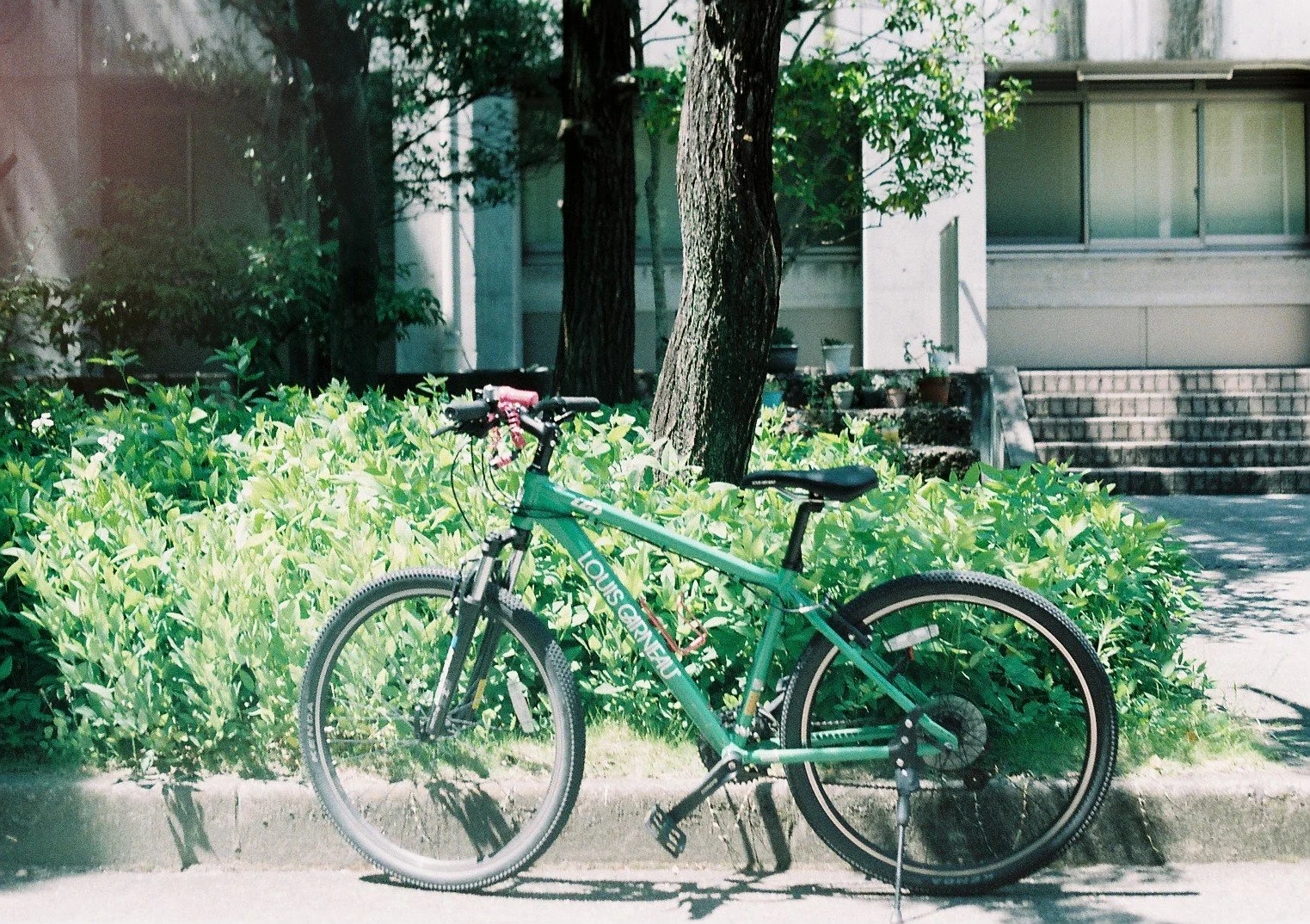
Photo by Mariam Kvaratskhelia
The assumption that cycling somehow does not belong to Georgian cities ignores a much longer and largely forgotten history. Shortly after bicycles appeared in Europe during the 19th century, cycling culture also emerged in Tbilisi. In 1888, the city established its first cyclists’ society. A few years later, in 1892, the first cycling track was constructed near today’s Marjanishvili Theatre. Historical records show that bicycles were not viewed merely as recreational objects or sports equipment. They were integrated into urban mobility itself.
The Georgian public figure Niko Nikoladze brought one of the first bicycles to Georgia in the late 19th century, shortly after bicycles became popular across Europe. Local merchants quickly recognized their practical value, and bicycles gradually became part of everyday urban circulation in Tbilisi. In other words, cycling in Georgia is not a foreign urban trend imported from Northern Europe decades later. It has its own local history.
This historical trajectory, however, was interrupted.
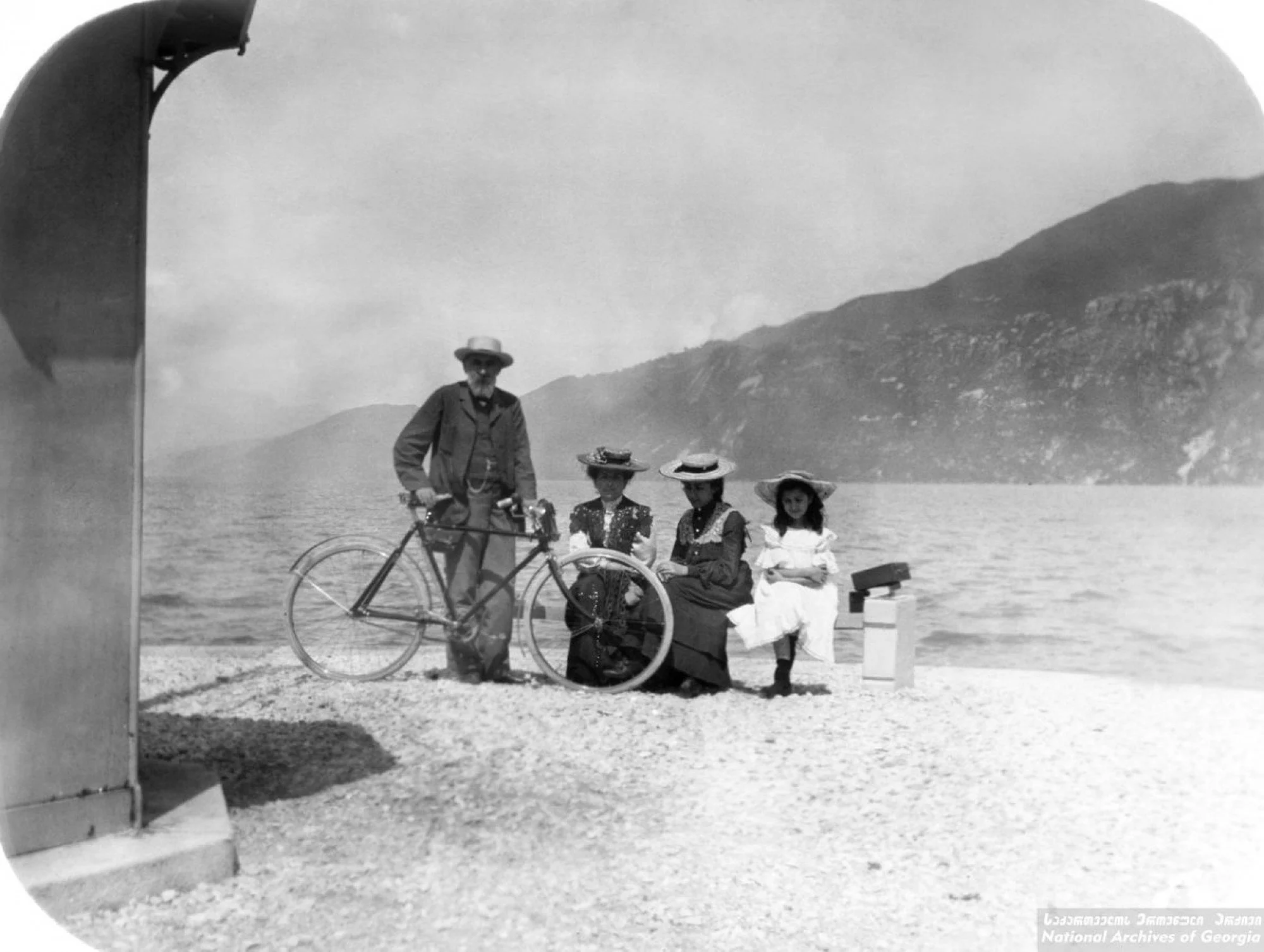
Niko Nikoladze and his family (1903), National Archives of Georgia
In 1905, bicycle traffic was banned on the streets of Tbilisi due to conflicts between cyclists and pedestrians. Soon afterward, Georgia became part of the Soviet Union, and mobility systems across the region were reshaped according to the logic of Soviet industrial modernity. Rapid industrialization, mass production, and modernist planning transformed the automobile into a symbol of technological progress and economic advancement. Cities increasingly became organized around speed, circulation, and motorized transport.
Like many other countries during the twentieth century, Georgia entered the age of automobiles not simply through individual choice, but through political and ideological transformation. The private car gradually evolved into a social aspiration, while bicycles became associated either with recreation or with economic necessity. The symbolic meaning of transport changed.
This historical shift still shapes urban culture today.
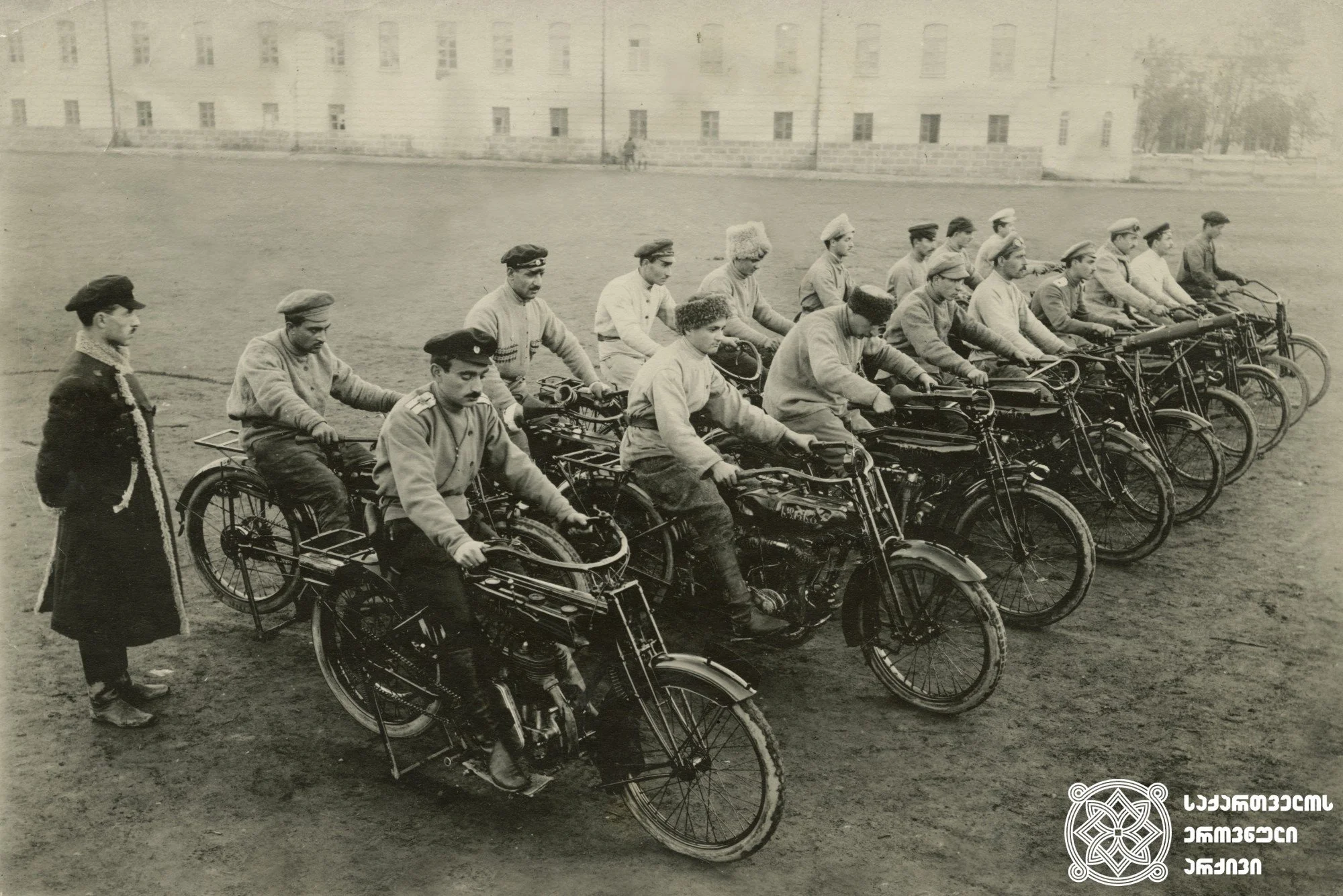
Cyclists’ machine-gun unite of the people’s guard. Tbilisi, 1918-1921, National Archives of Georgia
Many of these questions were explored in the 2024 research study Actual and Perceptual Barriers to Commuting Cycling in Georgia by Mariam Kvaratskhelia, which examined why commuting cycling remains underdeveloped in Georgian cities despite growing discussions around sustainable urban mobility. Combining survey data, in-depth interviews, and policy analysis, the research focused not only on physical and infrastructural obstacles, but also on the social, cultural, and psychological factors that shape transportation choices and public attitudes toward bicycles.
The findings confirm that poor cycling infrastructure and safety concerns remain among the strongest barriers to cycling in Georgian cities. Cyclists frequently point to high traffic speeds, disconnected or absent cycling networks, unsafe crossings, and the overall dominance of cars in urban space.
However, infrastructure alone does not fully explain why cycling still feels socially difficult in Georgia.
Mobility is also cultural.
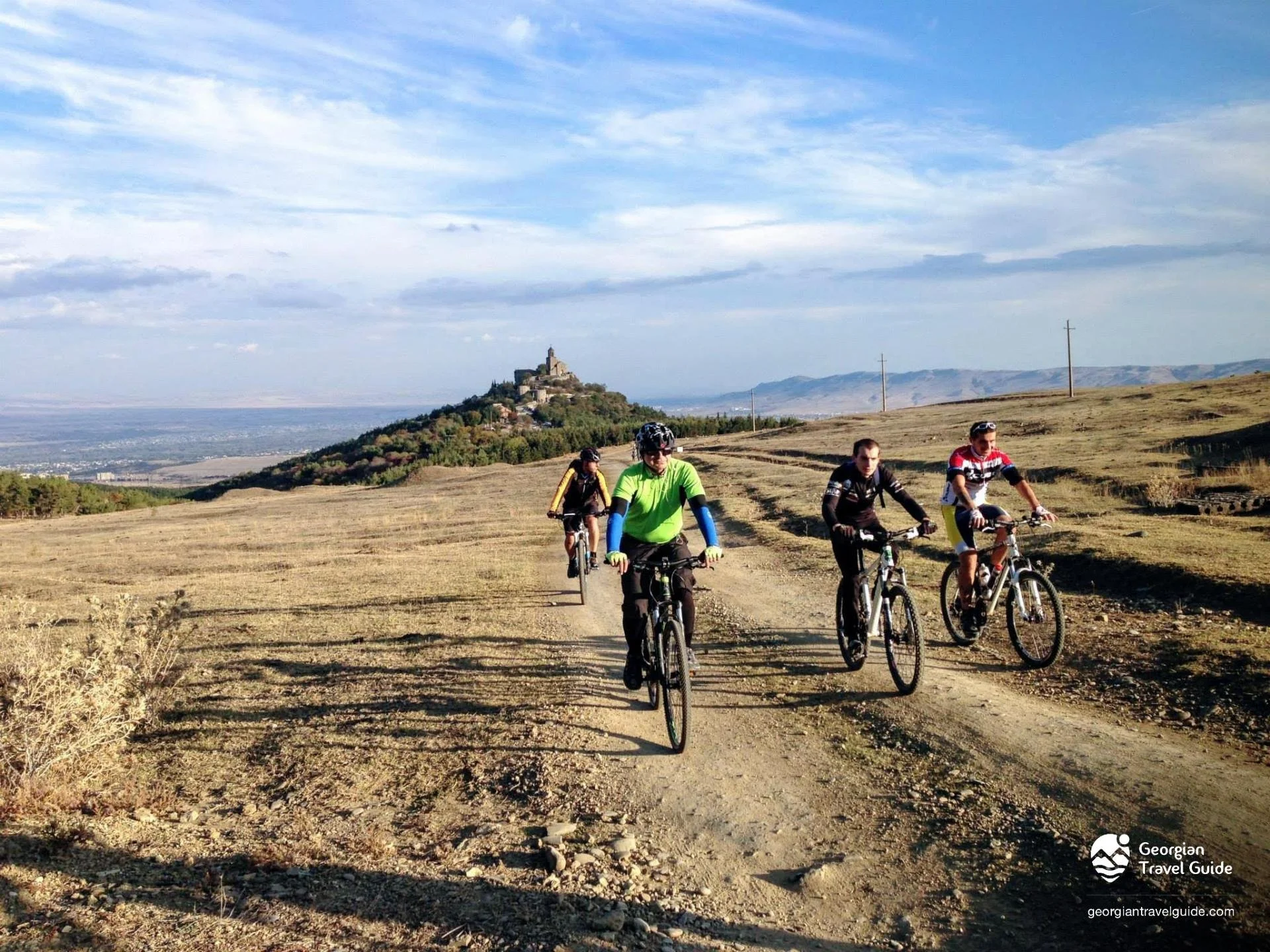
Georgian cyclists, photo by Georgian Travel Guide
Cycling in Georgian cities is still shaped by more than physical conditions. One of the most frequently mentioned perceptions is that Tbilisi is “too hilly” for cycling. While the city’s topography is real, this belief often exceeds the actual spatial reality. Many central areas are in fact suitable for cycling, but this is rarely reflected in everyday perception, shaped instead by limited exposure and the absence of visible cycling culture.
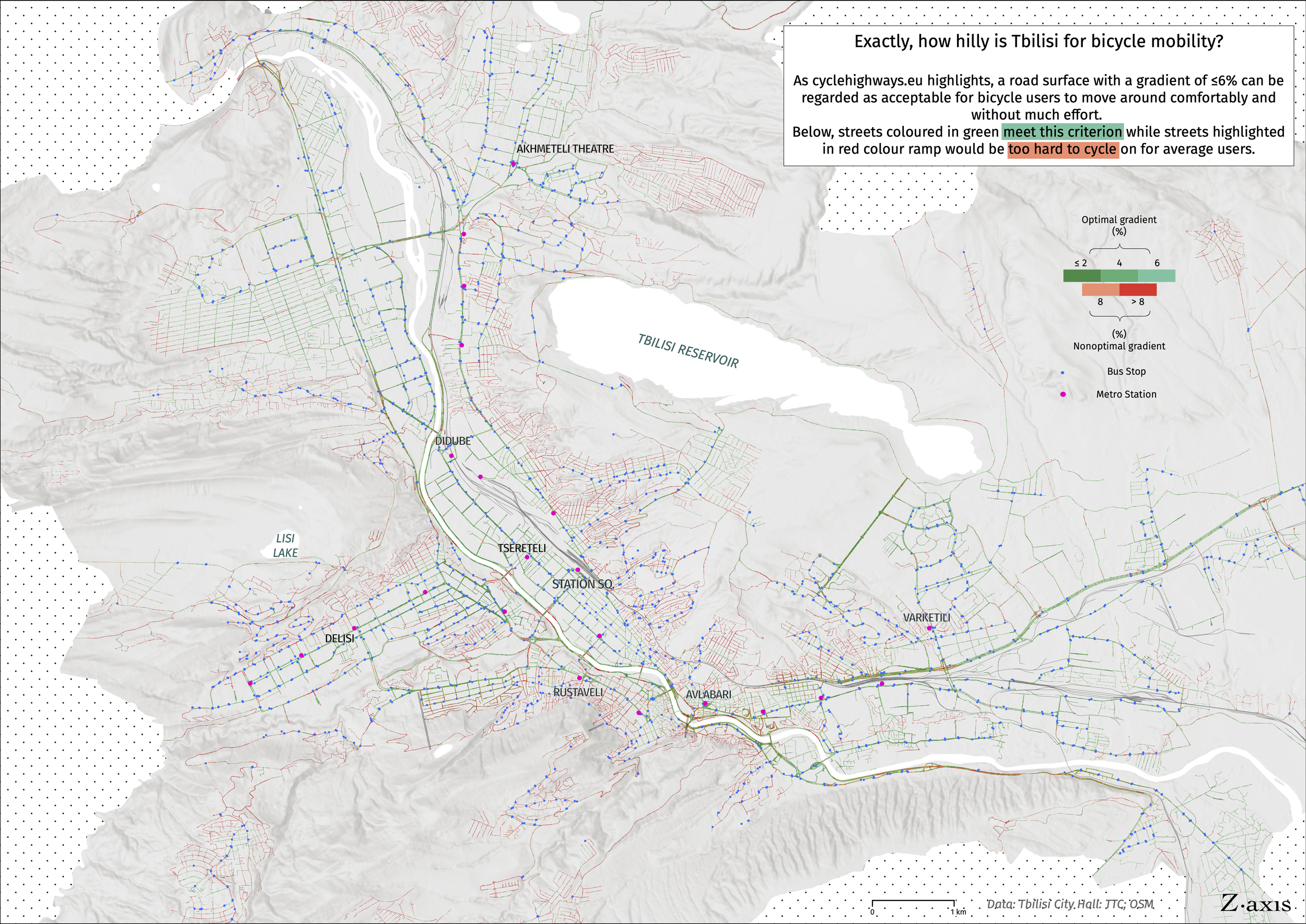
Street Slopes (%) in Tbilisi by Giorgi Kankia (2022)
Another locally specific finding relates to stray dogs, commonly present in urban space. Respondents described how dogs often react to fast-moving movement and may chase bicycles out of instinct rather than aggression. While not unique to Georgia, this interaction adds an unpredictable layer to everyday cycling and can discourage use in certain areas.

Toby, Photo by Mariam Kvaratskhelia
Taken together, the history of cycling in Georgia and the findings of the research point to a broader conclusion: mobility patterns are not shaped by infrastructure alone. They are produced through social norms, cultural meanings, and collective imagination of what a “modern” city looks like.
Kvaratskhelia, M. (2024). Actual and perceptual barriers to commuting cycling in Georgia (Master’s thesis, Kyoto University). Graduate School of Global Environmental Studies, Kyoto University.
Bicycle History. (n.d.). Pierre Michaux biography and facts – First bicycle prototype. Bicycle History – Evolution of Cycling. https://www.bicyclehistory.net/bicycle-inventor/pierre-michaux/
Kokheridze, M. (n.d.). ველოსიპედი. PERSONA GRATA. https://malkhazkokhreidze.wordpress.com/2019/07/06/%E1%83%95%E1%83%94%E1%83%9A%E1%83%9D%E1%83%A1%E1%83%98%E1%83%9E%E1%83%94%E1%83%93%E1%83%98/
National Arcihve of Georgia. Niko Nikoladze. https://archive.gov.ge/ge/2011-2015-1/niko-nikoladze-170-1
ქართული სპორტი. (n.d.). ველოსპორტი. ქართული სპორტი. https://sport.gov.ge/index.php?pg=sporttypes&sportid=12
Kokheridze, M. (n.d.). ველოსიპედი. PERSONA GRATA. https://malkhazkokhreidze.wordpress.com/2019/07/06/%E1%83%95%E1%83%94%E1%83%9A%E1%83%9D%E1%83%A1%E1%83%98%E1%83%9E%E1%83%94%E1%83%93%E1%83%98/
Pike, J. (2016, 3). Soviet Automotive Industry. Global Security. https://www.globalsecurity.org/military/world/russia/cccp-industry-auto.htm
Oosterhuis, Harry. (2016). Cycling, modernity and national culture. Social History. 41. 241. 10.1080/03071022.2016.1180897. https://doi.org/10.1080/03071022.2016.1180897
Bruntlett, C. (2018, December 26). No helmets, no problem: how the Dutch created a casual biking culture. Interview by D. Roberts. Vox. https://www.vox.com/science-and-health/2018/8/28/17789510/bike-cycling-netherlands-dutch-infrastructure
Oosterhuis, Harry. (2016). Cycling, modernity and national culture. Social History. 41. 248. 10.1080/03071022.2016.1180897. https://doi.org/10.1080/03071022.2016.1180897
